
Big Decisions Deserve Confidence
CA9 (CAIX) imaging could help make that happen
A new path forward for diagnosing kidney masses
Because imaging technology is limited, biopsy or surgery is currently needed in order to know if a kidney mass is cancer or not.
A new, noninvasive way to identify the most common type of kidney cancer (called clear cell renal cell carcinoma or ccRCC) may be able to help.
This tool, called a CA9 (or CAIX) scan, could potentially identify ccRCC:
- Without the need for surgery or biopsy
- Sooner
- With more accuracy
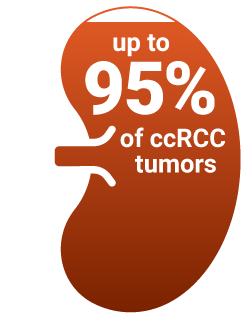
CA9, or carbonic anhydrase 9 (car-bon-ik an-hi-drase 9), is a protein found in up to 95% of all ccRCC tumors.
How does CA9 imaging work?

CA9 imaging is a specific kind of body scan that helps doctors see if a kidney mass is ccRCC or not. Under the supervision of a doctor, this is how CA9 scanning could work:
- An injection containing an ingredient called a tracer is given to you
- You will wait a few days for the tracer to circulate in your body
- While you are waiting, the tracer searches for and binds to a protein called CA9, if present. This protein is found on the surface of nearly all ccRCC cells
- A CA9 scan is performed
- If CA9 is there, it “lights up” on the images, suggesting ccRCC may be present

How CA9 scans could help guide treatment choices
With clearer information from a CA9 scan, you and your care team could potentially:
- Confirm if your mass is ccRCC or not, without needing surgery or a biopsy
- Base your treatment plan on an accurate diagnosis, so that you get the appropriate treatment for your situation
- Make decisions sooner, reducing the uncertainty that comes with treatment for undiagnosed kidney masses
- Potentially avoid some procedures by knowing more about your kidney mass